
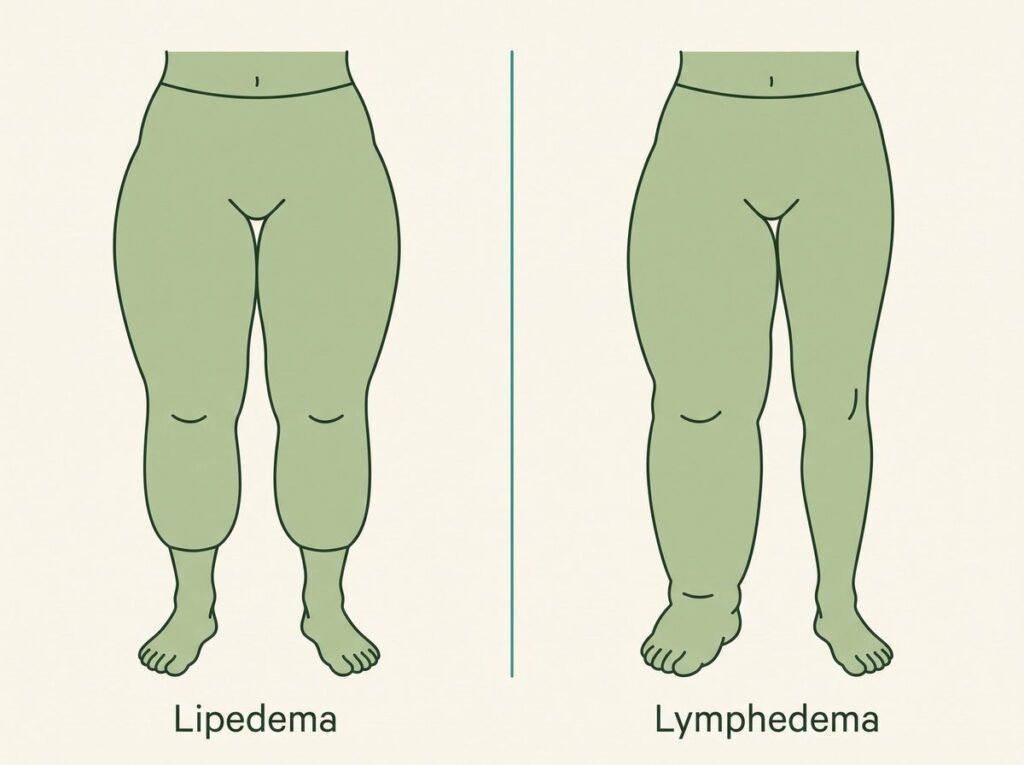
Lipedema is usually symmetrical, painful and tender, affects both legs and typically spares the feet. Lymphedema is often one-sided, usually involves the foot, and tends to feel heavy rather than tender. Ordinary swelling generally settles overnight and has an obvious cause. They can also occur together, which is why none of them can be diagnosed from a photograph.
The patterns clinicians look for
| Lipedema | Lymphedema | Ordinary swelling | |
|---|---|---|---|
| Sides affected | Both, symmetrical | Often one, or uneven | Usually both |
| Feet and hands | Usually spared, visible cuff at the ankle | Commonly involved | Often involved |
| Pain and tenderness | Characteristic | Less prominent, more heaviness | Usually none |
| Easy bruising | Common | Less typical | No |
| Settles with elevation | Little change | Often early on, less later | Usually yes, overnight |
| Typical onset | Often around puberty, pregnancy or menopause | After surgery, radiation, infection or injury, or present from birth | Heat, standing, long flights, salt, medication |
Real people do not always read the textbook. Plenty of presentations sit between these columns.
The ankle cuff
If the legs are enlarged but the feet look normal, leaving a visible step or cuff at the ankle, that pattern points toward lipedema rather than lymphedema.
It is one of the more useful distinguishing signs and one people often notice themselves without knowing it means anything.
Why pain matters diagnostically
Lipedema tissue is often tender, and people frequently bruise without remembering an injury. That combination is a genuine clinical feature, not a complaint to be brushed aside.
Lymphedema more often presents as heaviness, tightness or fullness than as tenderness. Ordinary swelling usually does not hurt at all.
If you have been telling people your legs hurt and been told it is just weight, that symptom is diagnostically relevant.
They can happen together
This is the part that gets missed.
Long-standing lipedema can be complicated by lymphatic overload, sometimes called lipo-lymphedema. Venous disease can be present too. So can obesity. Two or three of these together is common, and a person can have both a symmetrical tender pattern and a swollen foot on one side.
Assessment looks at the whole picture rather than forcing one label.
What ordinary swelling looks like
Swelling that appears after a long flight, a hot day, a lot of standing, or a new medication, and which settles overnight, is usually not either condition.
What makes swelling worth investigating is when it stops settling, when it affects one side only, when it comes with pain, or when it appears without an obvious reason.
Why a photograph cannot diagnose this
Lipedema cannot be diagnosed from a photograph or from body shape alone. Neither can lymphedema.
Diagnosis involves history, examination, how the tissue feels, whether it pits, whether the foot is involved, what happens with elevation, and ruling out other causes. Online image comparisons are a reasonable prompt to seek assessment, not a diagnosis.
When to get urgent care instead
Sudden swelling in one limb, especially with pain, warmth or redness, needs same-day medical attention. So does chest pain, shortness of breath or coughing up blood. These can indicate a blood clot.
A limb becoming red, hot and tender, with fever or feeling unwell, can indicate cellulitis and usually needs antibiotics.
Call Health Link at 811, or 911 if you are severely unwell. Do not book a massage for either.
Common questions
Can I have both lipedema and lymphedema? Yes. Long-standing lipedema can be complicated by lymphatic overload.
Will losing weight tell me which it is? No, and it is not a diagnostic test. The disproportion may remain even when overall weight changes.
Why do my legs hurt but the doctor says they look fine? Pain and tenderness are recognised features of lipedema, and it is commonly missed. It is reasonable to ask for assessment by someone who works with these conditions.
What should I bring to an assessment? Anything you have already been told, any imaging, a list of medications, and a sense of when it started and what changes it.
Sources
Herbst et al., Standard of Care for Lipedema in the United States. Faerber et al., S2k Guideline Lipedema, 2024. International Society of Lymphology 2023 Consensus Document. MyHealth Alberta.
CTA
If you have been told for years that it is just weight, book an assessment. We will tell you what we can and cannot determine from a physiotherapy assessment, and what to ask your doctor.
It is not a diagnosis or a treatment plan. If something here sounds like what you are dealing with, book an assessment and we will look at it properly.